

Penggunaan MetodeProblem Based Learning Untuk Meningkatkan Keaktifan dan Hasil Belajar Arsitektur, klasifikasi penguat daya audio Peserta Didik SMKN 1 Adiwerna
- Authors
-
-
Indriyanti
SMK N 1 Adiwerna Kabupaten Tegal
-
- Keywords:
- Problem Based Learning Methods, Learning Activities, Learning result
- Abstract
-
The research purposes to improve and definitive the increase in liveliness and learning result of students on basic architectural competencies, classification of audio power amplifier for students in class XI TAV 1 SMK N 1 Adiwerna Tegal even semester 2017/2018 school year. It was carried out in two circles by PBL (Problem Based Learning) method. The based on the research learning activity in the first cycle of students' learning activities was 50.78% and the second cycle was 80.87%. The learning result of cycle I were the percentage of the amount of students who had reached (fulfilling KKM) of 59.37%. In the second cycle the percentage of the total students who completed (has met KKM) amounted to 84.37%, which means that there has been an increase compared to the cycle I. Learning outcomes classically classified as complete (exceeding classical completeness) is 80%.
- Downloads
-
##plugins.themes.default.displayStats.noStats##
- References
- Downloads
- Published
- 01.05.2020
- Issue
- Vol. 14 No. 1 (2020)
- Section
- Articles
- License
-
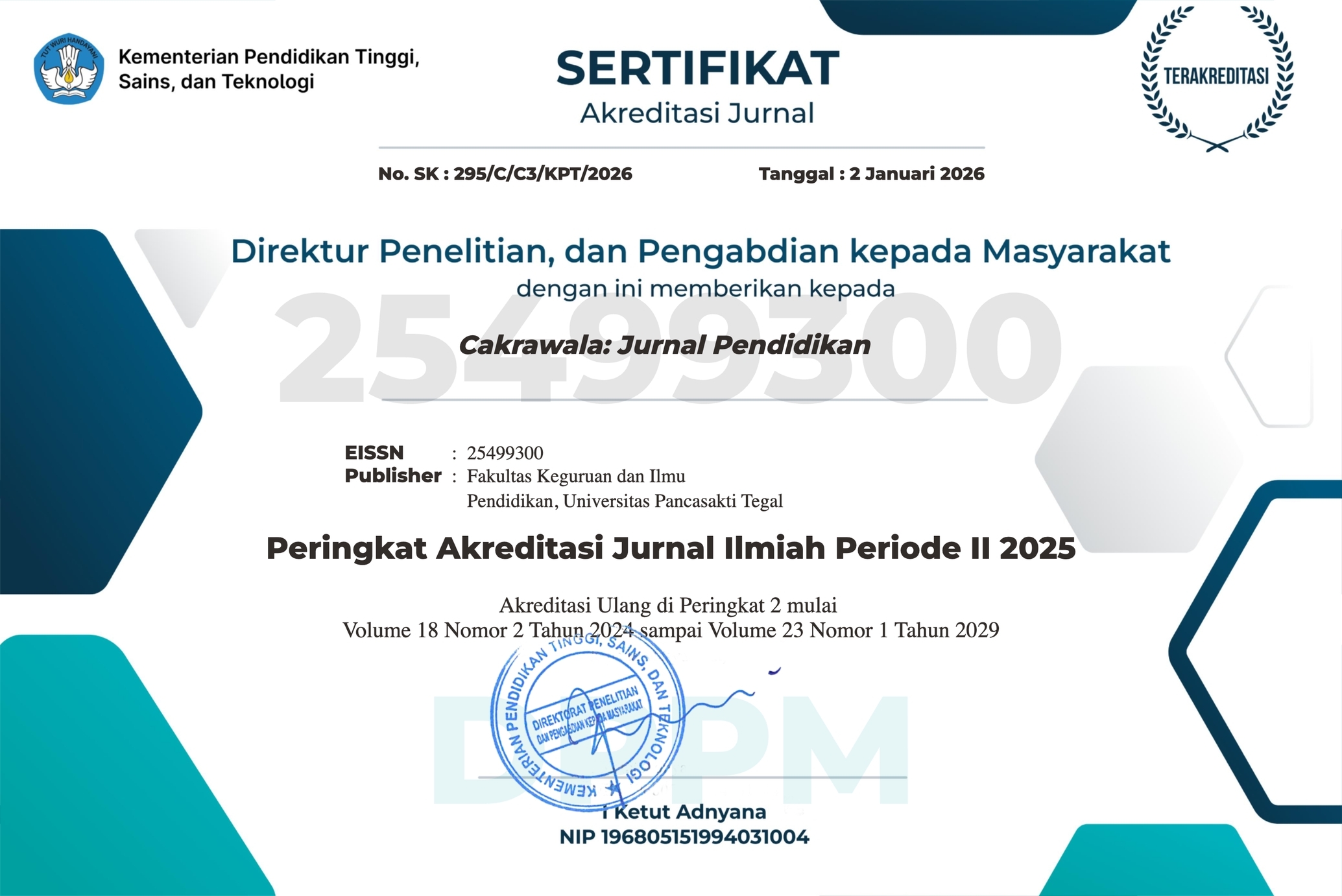
With the receipt of the article by the Editorial Board of the Cakrawala: Jurnal Ilmu Pendidikan and it was decided to be published, then the copyright regarding the article will be diverted to Cakrawala: Jurnal Ilmu Pendidikan.
Cakrawala: Jurnal Ilmu Pendidikan hold the copyright regarding all the published articles and has the right to multiply and distribute the article under Creative Commons Attribution-NonCommercial 4.0 International License.
A copyright transfer from the author to the journal is done by filling out the copyright transfer form by the author.
Copyright Transfer Letter: Download
Creative Commons Attribution-NonCommercial 4.0 International License
How to Cite
Similar Articles
- Melda Fajra, Ambiyar ambiyar, Fahmi Rizal, Oskah Dakhi, Wakhinuddin Simatupang, Pengembangan Model Evaluasi Kualitas Output Pembelajaran Teknik Komputer dan Jaringan di SMK Kota Padang , Cakrawala: Jurnal Pendidikan: Vol. 14 No. 1 (2020)
- Suharto, Peningkatan Motivasi dan Hasil Belajar Siswa pada Pembelajaran Lingkaran dengan Metode Penemuan Terbimbing , Cakrawala: Jurnal Pendidikan: Vol. 11 No. 2 (2017)
- Tity Kusrina, Mursyidah Dwi Hartati, Menggagas Revitalisasi Nilai Nilai Pancasila dalam Peran Masyarakat terhadap Generasi Muda Berbangsa dan Bernegara , Cakrawala: Jurnal Pendidikan: Vol. 13 No. 2 (2019)
- Tri Mulyono, Afsun Aulia Nirmala, Leli Triana, Indah Sri Nofitasari, Nilai Peduli Lingkungan Pada Puisi Anak Indonesia Karya Siti Aenah , Cakrawala: Jurnal Pendidikan: Vol. 18 No. 2 (2024)
- Ayu Putri Chiisai, Choirunnisa Adinda Prihatin , Novi Mardiani Putri, Sesya Dias Mumpuni, Analisis Faktor Holland Career pada Ketertarikan Food Photography Unit Kegiatan Mahasiswa KOPPI (Komunitas Photography Pancasakti) di Masa Pandemi Covid-19 , Cakrawala: Jurnal Pendidikan: Vol. 15 No. 2 (2021)
- Nur Laila Molla, The Efectiveness of Implementation Round Robin Technique in The Teaching of Writing for The Third Semester PBI Students of Pancasakti University Academic Year 2015/2016 , Cakrawala: Jurnal Pendidikan: Vol. 10 No. 1 (2016)
- Umida Ziyamukhamedova , Holiskhon Mahksudova, Yoga Prihatin, How to Teach Terminology to ESP Students , Cakrawala: Jurnal Pendidikan: Vol. 17 No. 2 (2023)
- Nenden Lu'lu Patimah, Sri Hardianti Sartika, Ati Sadiah, The Role of Think Talk Write Learning Model Assisted by Wordwall Media on Students’ Critical Thinking Skills , Cakrawala: Jurnal Pendidikan: Vol. 17 No. 2 (2023)
- Wiwit Fitriana, Diana Endah H, Pengembangan Papan Flanel Tema Pekerjaan Kelas III Sekolah Dasar , Cakrawala: Jurnal Pendidikan: Vol. 11 No. 2 (2017)
- Rina Novalinda, Nizwardi Jalinus, Jalius Jama, Evaluasi Penerapan Kurikulum 2013 di SMK Negeri 1 Payakumbuh , Cakrawala: Jurnal Pendidikan: Vol. 14 No. 1 (2020)
You may also start an advanced similarity search for this article.