

Penguatan Sikap Peduli Lingkungan Peserta Didik melalui Pendekatan Jelajah Alam Sekitar (JAS) Berbasis Model Problem Base Learning (PBL)
- Authors
-
-
- Keywords:
- JAS Approach, PBL, Environmental Attitufde
- Abstract
-
This study aims to determine the effect of the “Jelajah Alam Sekitar”/ Approach of Natural Around (JAS) Based on the Problem Base Learning Model (PBL) Through Observation of Pollution Indicators Towards Learners' Environmental Care Attitudes. The data analysis of this study was divided into two, namely the initial data analysis in the form of a validity test using product moment correlation, reliability test and final data analysis in the form of a final data test covering descriptive analysis, normality test, homogeneity test, t test (paired sample t test) , descriptive attitude care about the environment. The results showed that the learning of science based on the JAS approach with the PBL method on environmental attitudes of students on the theme of pollution is influential because by using the t test (paired sample t test) the sig (2-tailed) value of 0,000 <0.05 was obtained. Learning by using a Natural Approach to explore around the PBL Model based can be applied in the eyes of natural science students, especially in environmental pollution material because according to this research Approach to the Natural Approach Around the PBL model based can improve students' environmental care attitudes
- Downloads
-
##plugins.themes.default.displayStats.noStats##
- References
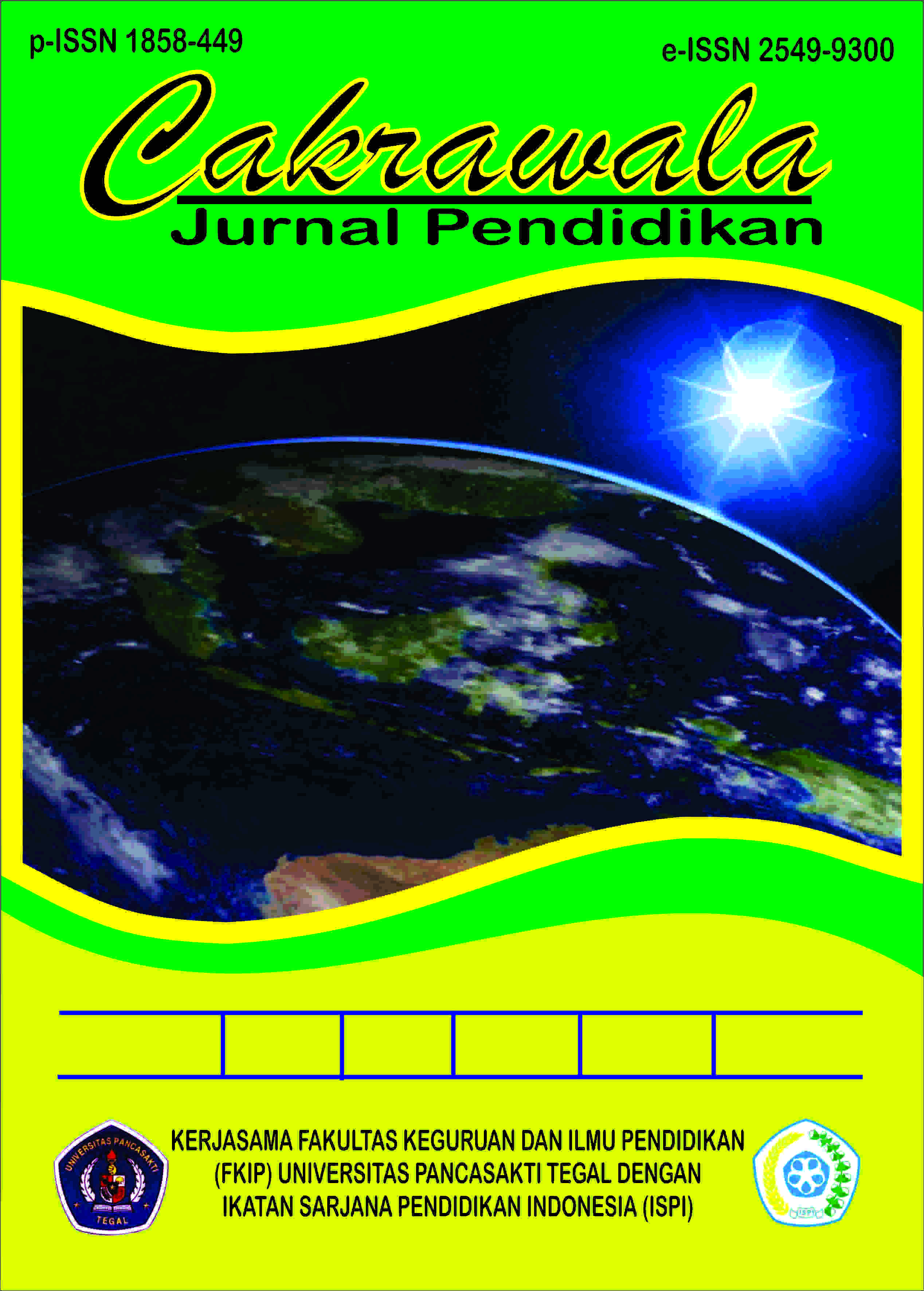
- Cover Image
-
- Downloads
- Published
- 01.11.2019
- Issue
- Vol. 13 No. 2 (2019)
- Section
- Articles
- License
-
With the receipt of the article by the Editorial Board of the Cakrawala: Jurnal Ilmu Pendidikan and it was decided to be published, then the copyright regarding the article will be diverted to Cakrawala: Jurnal Ilmu Pendidikan.
Cakrawala: Jurnal Ilmu Pendidikan hold the copyright regarding all the published articles and has the right to multiply and distribute the article under Creative Commons Attribution-NonCommercial 4.0 International License.
A copyright transfer from the author to the journal is done by filling out the copyright transfer form by the author.
Copyright Transfer Letter: Download
Creative Commons Attribution-NonCommercial 4.0 International License
How to Cite
Similar Articles
- Purnomo Agung, Muljani Sutji, Rancangan Pembelajaran Berkarakteristik dan Inovatif Abad 21 pada Materi Gelombang dengan Model Pembelajaran Discovery Learning di SMKN 1 Dukuhturi , Cakrawala: Jurnal Pendidikan: Special Issue: Pedagogy in Indonesia
- Nursyam, Analisis Pembelajaran Bisnis Online Dengan Menggunakan Model Pembelajaran Discovery, Problem Based, Dan Project Based Learning , Cakrawala: Jurnal Pendidikan: Special Issue: Pedagogy in Indonesia
- Mita Reksaningrum, Sutjie Muljani, Pembelajaran Berkarakteristik Pembelajaran Inovatif Abad 21 pada Materi Transformasi Geometri dengan Model Pembelajaran discovery Learning di SMK Bina Nusa Slawi Kabupaten Tegal , Cakrawala: Jurnal Pendidikan: Special Issue: Pedagogy in Indonesia
- Sumartono, Developing Foreign Language Proficiency Through Speech Leaning in Early Childhood , Cakrawala: Jurnal Pendidikan: Vol. 4 No. 7 (2010)
- Winarko, Peningkatan Motivasi Dan Hasil Belajar Mata Pelajaran Penjasorkes Materi Permainan Bola Voli Melalui Model E’i Berbantuan Gadis Desa Pada Siswa Kelas VII G SMP Negeri 2 Balapulang Semester Ganjil Tahun Pelajaran 2016/2017 , Cakrawala: Jurnal Pendidikan: Vol. 11 No. 1 (2017)
- Yulia Nur Ekawati, Dahlya Indra Nurwanti, Anin Eka Sulistyawti, Pengaruh Penerapan Permainan Tradisional Tegal Terhadap Kemampuan Kerjasama Anak-Anak , Cakrawala: Jurnal Pendidikan: Vol. 9 No. 1 (2015)
You may also start an advanced similarity search for this article.
Most read articles by the same author(s)
- Danty Kusmianty, Bayu Widiyanto, Mobinta Kusuma, Efektivitas Model Pembelajaran Sets Metode Praktikum Pada Materi Pemanasan Global Dalam Meningkatkan Kemampuan Berpikir Kritis , Cakrawala: Jurnal Pendidikan: Vol. 14 No. 1 (2020)
- Bayu Widiyanto, Penerapan Metode Field trip pada MK. Pendidikan Lingkungan Hidup untuk Meningkatkan Kepedulian Mahasiswa terhadap Permasalahan Sampah , Cakrawala: Jurnal Pendidikan: Vol. 11 No. 2 (2017)
- Mobinta Kusuma, Inequality Effect of Metacognition and Adaptivity Skill in Science Achievement of Indonesia Students , Cakrawala: Jurnal Pendidikan: Vol. 15 No. 1 (2021)